
I’m no expert on Studebaker but this is what I have noticed. Rather than being a focused manufacturer they seemed to make something for everyone. They started business building farm wagons and those were some of the last vehicles to roll out of the factories as they switched to motor vehicles. Studebaker built great fleets of military and municipal vehicles. They mass produced runabouts, sulkies and surreys in huge numbers for the general public and built limited high end carriages to appeal to the social elite.

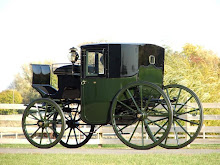
I have had the pleasure of owning a number of Studebaker carriages over the years that I can say I have really enjoyed. The mass production carriages are pretty much like everyone else’s mass production carriages so no big deal. But the unique sporting and formal carriages are of outstanding quality and design. There is something very American feeling about the style of Studebaker carriages. Hard to describe but uniquely American. I think I’m correct in calling this vehicle a Sailor Wagon. It is a snappy little cut under carriage with a folding grooms seat that I happen to be quite taken by.

Here you can clearly see the groom seat in the upright position. The sides of the rails fold inward for clearance when the seat is stowed under the driver seat. The hinges are visible but the joints are so tight that they are difficult to see even up close. This entire mechanism still works just like the day it was built.

The oil caps are marked Studebaker New York which I would assume meant that it was produced in the New York factory. Over the years I have had vehicles marked Studebaker Brothers, Studebaker South Bend, Studebaker Chicago, and Studebaker New York. All four oil caps are in place and marked.

This carriage has some fantastic details. The raised trim on the body is unique and quite similar to details used in a Bronson Wagon. I really like the way the hand rail is designed on the driver seat with the step and double rail section. Very unique and appealing to the eye. The driver seat is hinged and folds upward for storage of the rear groom seat.

I love this detail on the body supports. The little wood block or cube on the end of the spring block is so different. I can’t recall seeing this design detail before so it really caught my eye. Right now the carriage is in natural finish. It has been restored but a long time ago the way it looks. I’m not sure if it was originally a painted vehicle or natural. I have not had the time to really examine it quite that closely. The body has a couple small damage issues that might be a challenge if we are going to leave it natural so we’ll see.
The only other real problem with the carriage are the wheels. When it was last restored they must have found a pair at the “Island Of Misfit Wheels” and installed then on the back. The front wheels appear to be original and correct. Count the spokes. Ten in the front means there should be twelve in the back. I count fourteen so that was the first sign. The hubs and fellows are not a match either. The fronts are interesting in their design. First off they have a really attractive hub. Secondly the fellows are a tapered profile almost in keeping with a Brewster fellow. They are wider at the spoke than they are at the steel. The fellows also lack any shaping between the spokes so the crisp edge of the fellow carries completely around the circumference of the rim. We are in the process of making two new wheels for the rear that will be an exact match to the front. Then we will be ready to dive into restoration of this great American classic.
Enjoy your weekend.
Best!
Todd




 Posts
Posts


